

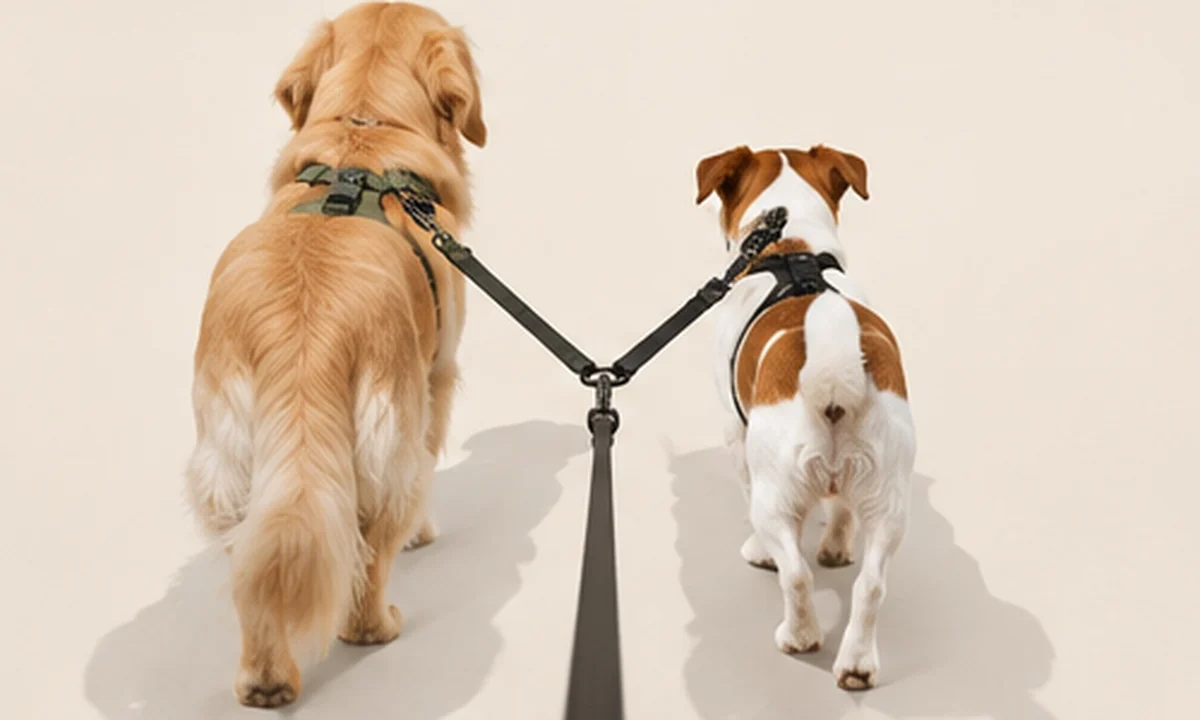

Walking one dog is a routine. Walking two can feel like a rope-skipping contest, especially on the day one of them spots a cat. The fix is not strength or luck. It is the right hardware, plus a pair of dogs who have each learned to walk properly on their own.
First, Decide on Your Setup
There are three workable ways to walk two dogs, and the best one depends on your pair:
- Two leashes, two hands. The most control and the least tangling, as long as you are comfortable holding both. Best when your dogs are very different sizes, or when one of them needs close management.
- A coupler leash. One handle, two clips on a short Y-shaped strap. One hand free, both dogs moving at the same pace.
- A hands-free belt. The leash attaches to a padded waist belt so both hands stay free. Comfortable on long walks, but it takes practice to steer two dogs from your hips.
The Coupler Leash: The Fastest Fix for Tangling
A coupler is the shortest route to a walk that does not involve untangling yourself every thirty seconds. It clips to both dogs and attaches to a single leash, with a swivel joint so the two leads rotate independently. That swivel is the part worth checking: without it, two dogs turning in opposite directions will twist the strap into a knot.
Our Double Dog Coupler Leash is built for exactly this job, and it pairs naturally with a reflective leash for evening walks.
One honest caveat: a coupler only works when both dogs already walk reasonably well on their own. Hook a dedicated puller to a well-behaved dog and you have simply created two pullers.
Train Them Separately First
This is the step most owners skip, and it is the reason so many two-dog walks go badly. Each dog should be able to walk on a loose leash alone before you expect them to do it together. A dog who cannot walk nicely solo will not magically learn while competing with a housemate for the same patch of pavement.
Spend two or three weeks on individual walks. Ten focused minutes per dog beats a chaotic hour together.
The Two-Dog Walk Routine
- Gear up inside the house. Harnesses and leashes on before the front door opens. A dog already bouncing at the doorway has no attention left for you.
- Exit one dog at a time. It feels slow for three days and saves you a month of chaos.
- Keep both dogs on the same side. Both on your left, rather than one on each side, keeps the leashes in one plane and stops them crossing your body.
- Stop when it tangles. Do not keep walking while you untangle. Stop, reset, and only set off once both leads are slack.
- Reward the calm. Treats for walking side by side, in the position you actually want them in.
Carry the Right Gear
Two dogs means double the logistics. A treat pouch you can reach with one hand matters more than it sounds, a leash-mounted waste bag dispenser saves you rummaging in a pocket while holding two leads, and a portable water bottle earns its place on warm days.
The Short Version
Choose one of the three setups and stop improvising. Teach each dog to walk alone before you walk them together. Keep both dogs on the same side of your body. The first two weeks will be slower than walking them separately, and after that the two-dog walk becomes the easiest part of your day.